- Pickford carried 85 senior England caps into England’s opening World Cup fixture
- His Croatia display extended a record haul of major tournament appearances for Everton
- Everton’s international goalkeeping lineage stretches back over a century to 1921
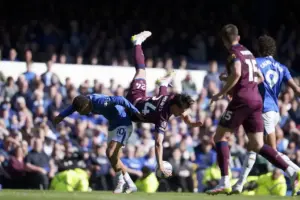
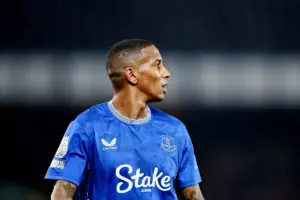
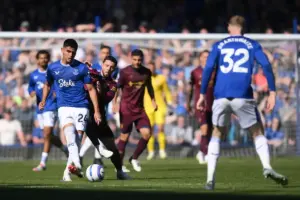
Jordan Pickford was at his authoritative best as England opened their 2026 World Cup campaign with that 4-2 victory over Croatia last night – a performance that adds another chapter to a lesser-celebrated but most enduring Everton tradition.
The Everton number one was composed, commanding and decent with his distribution throughout, providing the platform from which Thomas Tuchel’s side built a result that will have raised spirits across the England camp, and the country as a whole.
His display against Croatia extended an already remarkable record: no England goalkeeper has appeared in more World Cup and European Championship matches while contracted to a club than Pickford, a distinction that places him among some of Everton’s greats.
1920s
That history begins, perhaps surprisingly, in 1921, with Benjamin Howard Baker – amateur, Olympian, British high jump record holder, and a man of many talents. Baker played just the one senior England cap while at Everton, a clean sheet in a 2-0 win over Belgium in May of that year, before moving to Chelsea later in the same autumn.
His second international appearance came four years later, by which point he had long since left Merseyside. He remains, by some distance, the most extraordinary individual ever to occupy the Goodison goal.
1930s
Ted Sagar, the club’s legendary long-serving custodian, earned four England caps across 1935 and 1936, his international career a fraction of what it might have been had the war not intervened. He made close to 500 appearances for Everton and his record stood as a club benchmark for decades.
1950s and 1960s
Jimmy O’Neill brought industry and reliability to the role throughout the 1950s, accumulating 17 caps for the Republic of Ireland while spending the entire decade at Goodison.
Gordon West, one of the greats of his era, collected three England caps between 1968 and 1969 – his opportunities restricted only by the excellence of Gordon Banks in what was one of the most competitive goalkeeping eras in English football.
1980s and 1990s
George Wood earned three of his four Scotland caps while at Everton in 1979, the fourth coming after his move to Arsenal in 1982.
Then came the era that defines Everton goalkeepers. Neville Southall accumulated 92 caps for Wales between 1982 and 1998, all but one earned as an Everton player, the sole exception coming during a brief loan spell at Port Vale in the early stages of his career.
He remains among the finest goalkeepers Wales has ever produced and, by the assessment of most observers, one of the best. It’s a travesty that he never played in a World Cup Finals tournament.
Thomas Myhre served as Norway’s first-choice goalkeeper during the 1998 World Cup while establishing himself on Merseyside.
21st century…
Jan Mucha represented Slovakia on multiple occasions between 2010 and 2013 during his time as a backup at the club.
Robin Olsen continued adding to his Sweden caps across his loan season in 2020-21, and Asmir Begovic represented Bosnia and Herzegovina throughout his spell at Everton.
Tim Howard stands in a category of his own in terms of numbers. The most capped goalkeeper in USMNT history, his 121 international appearances were accumulated predominantly during a decade of exceptional service at Everton between 2007 and 2016 – a period in which he became one of the most respected figures in the club’s modern history.
And then there was Pickford. He arrived at Goodison in 2017 for £30 million from Sunderland and has scarcely put a glove wrong for club or country since. Against Croatia, he was everything England needed him to be: calm under pressure, decisive in the air, and good with the ball at his feet.
He is 32 now, and this is his third World Cup, and he shows no indication whatsoever of stepping aside. And why should he?
The line from Baker to Pickford spans more than a century. It is not a story Everton shout about particularly loudly. Maybe they should.