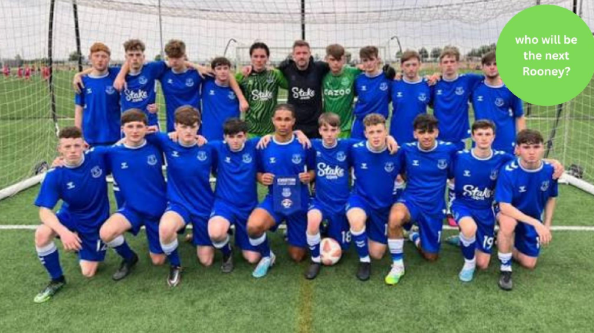

Founded in 1878, Everton Football Club has built one of English football’s most respected talent development systems.
From Wayne Rooney’s jaw-dropping goal against Arsenal at just 16 to John Stones becoming a Champions League winner with Manchester City, the Everton FC academy has consistently produced players who shape the game at the highest level.
According to Betiton, academy-developed footballers remain among the most valuable assets any Premier League club can possess.
A look at Everton FC’s academy
Historical context and founding principles
The academy operates under a philosophy as uncompromising as the club’s Latin motto: “Nil Satis Nisi Optimum,” which translates directly as “Nothing but the Best.” This standard permeates every level of the development pathway, from grassroots coaching sessions to the professional Under-21 squad competing in Premier League 2. Every coach, every training drill and every player assessment reflects this institutional commitment to excellence.
The Everton Football College, now relocated to Goodison Park Stadium from September 2025, currently welcomes 202 students studying Level 2 and Level 3 BTEC Sport or Business in partnership with Liverpool Business College. Head of Everton Football College Maxine Spooner leads an institution that earned a 100% parent recommendation rate in November 2022. The People’s Learning Trust, which oversees the college, was named TES Trust of the Year 2026.
Scope and global reach
The academy’s influence extends far beyond Merseyside. The Everton International Academy Affiliate Programme, launched in 2020, maintains active partnerships across the United States, Canada, South America, Africa, Australia and Ireland. Pike Fury FC stands as one official affiliate, with all registered players and coaches automatically enrolled in the programme.
| Programme feature | Details |
|---|---|
| Launch year | 2020 |
| Curriculum | Premier League Coaching Curriculum |
| Focus | Character, discipline, technical development |
| Regions covered | USA, Canada, South America, Africa, Australia, Ireland |
Monthly coach engagement meetings ensure that affiliate partners stay aligned with Everton’s development standards. This global network means the academy’s coaching philosophy reaches young players on multiple continents, creating a truly international talent pipeline feeding into the club’s structure.
The foundation and history of the academy
Early development and competitive pedigree
Decades before Finch Farm existed, Everton’s youth teams were already winning silverware. The Central League titles in 1914, 1938, 1954 and 1968 demonstrate a competitive consistency spanning half a century. Three FA Youth Cup victories, in 1965, 1984 and 1998, bookend different generations of talent. Four runners-up finish in 1961, 1977, 1983 and 2002 show the academy reached finals in virtually every era.
| Competition | Victories | Years |
|---|---|---|
| FA Youth Cup | 3 | 1965, 1984, 1998 |
| Central League | 4 | 1914, 1938, 1954, 1968 |
| Liverpool Senior Cup | 41 wins + 6 joint wins | 1884–2025 |
| Lancashire Senior Cup | 7 | 1894, 1897, 1910, 1935, 1940, 1964, 2016 |
The Liverpool Senior Cup record alone, spanning 1884 to 2025 with 41 outright wins and 6 joint victories, provides compelling evidence of sustained local dominance across multiple generations of academy players.
Finch Farm and the modern era
The completion of Finch Farm training complex in 2007 marked a genuine turning point. Both the Under-21 and Development squads now base their operations at this state-of-the-art facility, which provides world-class training environments that rival anything available in English football.
Modern era honours accumulated quickly after this infrastructure upgrade:
- Premier League 2 titles: 2016-17 and 2018-19
- Premier League Cup: 2019
- U18 Premier League: 2014
- CEE Cup: 2017
- Premier Academy League: 2011
- SuperCupNI Elite: 2016 (plus 7 Junior category wins)
Player of the season tradition
Since 2006, the academy has recognised outstanding individual performers annually. The roll call reads like a who’s who of modern British football:
| Year | Recipient | Position |
|---|---|---|
| 2006 | Victor Anichebe | Forward |
| 2009 | Kieran Agard | Forward |
| 2010 | Shane Duffy | Defender |
| 2011 | Jose Baxter | Midfielder |
| 2012 | Adam Forshaw | Midfielder |
| 2014 | Tyias Browning | Defender |
| 2015 | Brendan Galloway | Defender |
| 2016 | Joe Williams | Midfielder |
| 2017 | Jonjoe Kenny | Defender |
| 2018 | Morgan Feeney | Defender |
| 2019 | Nathan Broadhead | Forward |
| 2020 | Anthony Gordon | Forward |
No recipients were listed for 2022, 2023, 2024 or 2025. The awards nonetheless represent twelve years of formally documented talent recognition, each recipient a marker of the academy’s development standards at a given moment.
Wayne Rooney: a generational talent
Early signs of exceptional ability
Wayne Rooney’s story remains the defining chapter in Everton academy history. Coaches recognised almost immediately that this youngster from Croxteth possessed something extraordinary: a rare combination of physical aggression, technical precision and footballing intelligence that simply didn’t belong in age-group football.
His development pathway through the academy was handled carefully. Staff understood they were dealing with a once-in-a-generation prospect, not just another talented forward. The coaching environment at Everton gave him competitive intensity without breaking his natural instincts.
Breakthrough and global recognition
October 2002. Rooney, aged 16, struck a last-minute winner against Arsenal’s unbeaten side. That single moment announced the Everton academy to the world. It validated years of patient development and demonstrated what structured coaching combined with extraordinary natural talent could produce.
His subsequent career at Manchester United, where he became the club’s all-time top scorer with 253 goals, and with England, set a benchmark no academy graduate has yet surpassed. Every young forward walking through Finch Farm’s doors trains in the shadow of that legacy.
Ross Barkley: the homegrown midfielder
Academy pathway and first-team emergence
Ross Barkley joined Everton as a boy and progressed through every single age group within the academy system. His physical power, dribbling instinct and shooting ability from distance made him the most exciting English midfielder of his generation during his teenage years. Managers David Moyes and Roberto Martinez both recognised his exceptional qualities and trusted him with first-team minutes early.
His ability to drive at defenders, combined with incisive passing and composure under pressure, drew England selectors’ attention rapidly. Barkley represents the purest version of what the academy aims to produce: a player developed entirely within the club’s coaching framework reaching the very top of the game.
Significance as a homegrown product
Frankly, Barkley’s trajectory validated every penny invested in Goodison Park’s development infrastructure. Players grown from within the system carry the club’s DNA differently from those recruited externally. His story connects directly to the academy’s mission of producing homegrown talent who understand Everton’s standards instinctively, standards captured perfectly in “Nil Satis Nisi Optimum.”
John Stones: from academy to elite status
Arrival and technical development
John Stones arrived from Barnsley as a teenager with raw technical gifts that the Everton coaching staff recognised and nurtured intelligently. His willingness to play out from the back, his composure under pressing and his reading of defensive situations marked him as a radically different type of centre-back from the traditional English mould.
Crucially, Everton’s coaches encouraged these qualities rather than suppressing them. That decision proved transformative. Stones became one of the Premier League’s most technically accomplished defenders precisely because the academy environment gave him freedom to develop his distinctive style.
Rise and lasting legacy
His transfer to Manchester City opened the door to multiple Premier League titles and a Champions League winners medal. Every trophy Stones lifted validated the development he received during those formative professional years at Finch Farm. His success directly elevated the academy’s international reputation as a place that produces technically sophisticated defenders capable of operating at Champions League level.
| Player | Position | Academy years | Notable achievement |
|---|---|---|---|
| Wayne Rooney | Forward | Early 2000s | England’s all-time top scorer |
| Ross Barkley | Midfielder | 2000s–2010s | Full England international |
| John Stones | Defender | 2010s | Champions League winner |
| Jonjoe Kenny | Defender | 2010s | Academy Player of Year 2017 |
| Anthony Gordon | Forward | 2010s–2020s | Academy Player of Year 2020 |
The academy’s impact on club success
Competitive honours across all eras
The academy’s trophy record spans over a century of competitive football. Three FA Youth Cup victories in 1965, 1984 and 1998 sit alongside four Central League titles and two Premier League 2 championships. The SuperCupNI record alone tells a compelling story: seven Junior category victories across 1995, 2002, 2008, 2009, 2011 and 2013, plus the Elite win in 2016 and three runners-up finishes in 1999, 2004 and 2012.
These results are not accidents. They reflect consistent coaching quality, strong recruitment and an institutional culture that expects winners at every age group level.
Financial and sporting value
Homegrown players offer two distinct forms of value. Sportingly, they arrive in the first team already shaped by the club’s identity. Financially, graduates like Stones and Rooney generated transfer fees that funded significant squad investment. The academy functions simultaneously as a talent pipeline and a financial asset, a dual purpose few Premier League development programmes execute as effectively.
Conclusion
Everton’s academy has long embodied its motto of “Nothing but the Best,” turning local talent and carefully nurtured arrivals into players who shaped both the club and the wider game. From Rooney’s explosive breakthrough to Stones’ Champions League success and Barkley’s pure homegrown pedigree, the pathway from Finch Farm has repeatedly delivered elite performers.
Beyond individual stars, the consistent silverware and global affiliate network prove a development model that balances sporting excellence with lasting financial value. In short, the academy remains one of English football’s most reliable engines for producing players who leave a genuine mark.




Comments.
Loading comments…