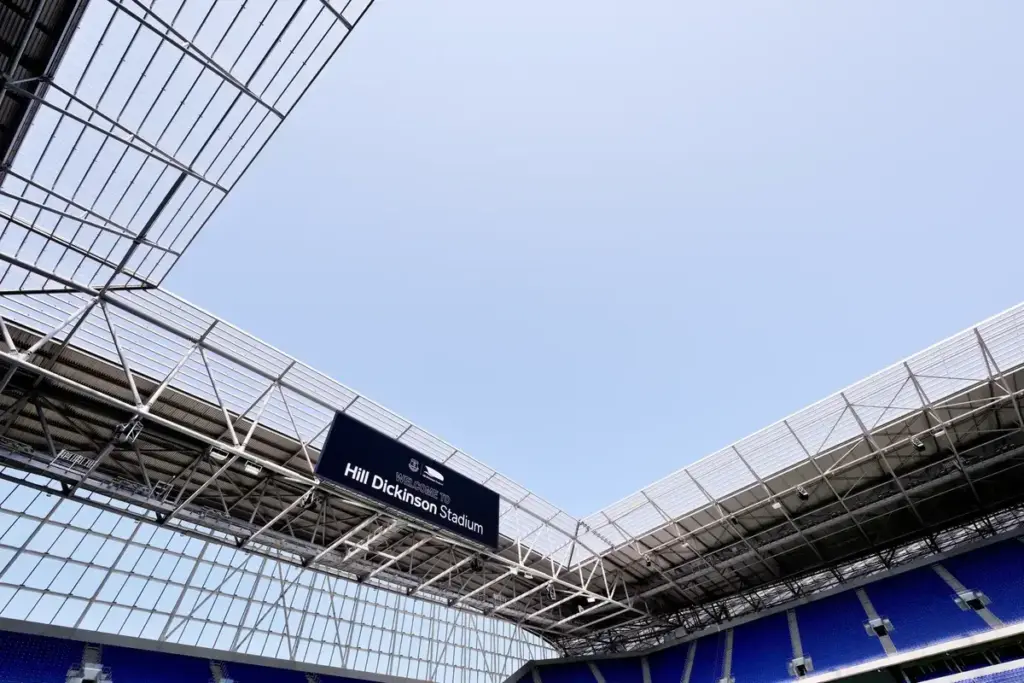

Everton’s position under the Premier League’s new Squad Cost Ratio rules, tracked throughout 2026/27 as transfers and new financial information change the picture.
Because clubs’ actual Squad Cost Ratio figures are not published in real time, every percentage and headroom figure on this page should be treated as an estimate. Where we have used modelling, we identify the source. These are not confirmed Premier League figures.
Last updated: 20 August 2026
How Squad Cost Ratio works
The Premier League has replaced Profitability and Sustainability Rules (PSR) with a Squad Cost Ratio system for 2026/27.
For clubs not competing in UEFA competition, including Everton this season, the key green threshold is 85% of relevant football revenue.
In simple terms, the calculation measures spending on player and head coach wages, transfer amortisation and agents’ fees against the club’s relevant football income.
There is also a red threshold at 115%. Moving beyond 85% can lead to a financial levy, while reaching the higher threshold brings the possibility of sporting sanctions.
That distinction is important. A club operating above 85% has not necessarily breached the rules in the sense supporters may associate with the old PSR system.
Nor is there an official public league table showing every club’s SCR position throughout the season. The Premier League assesses clubs using financial information submitted under its regulations, meaning any attempt to calculate Everton’s position during the campaign inevitably involves estimates.
Where Everton are estimated to stand
Everton’s most recent published accounts, covering 2024/25, recorded turnover of £196.7m and staff costs of £152.1m.
That produces a simple staff-cost-to-turnover ratio of approximately 77%, but it is not Everton’s Squad Cost Ratio.
SCR includes other costs — notably transfer amortisation and agents’ fees — while the revenue figure used for the calculation will also differ from the £196.7m turnover reported in those accounts.
There is another important factor.
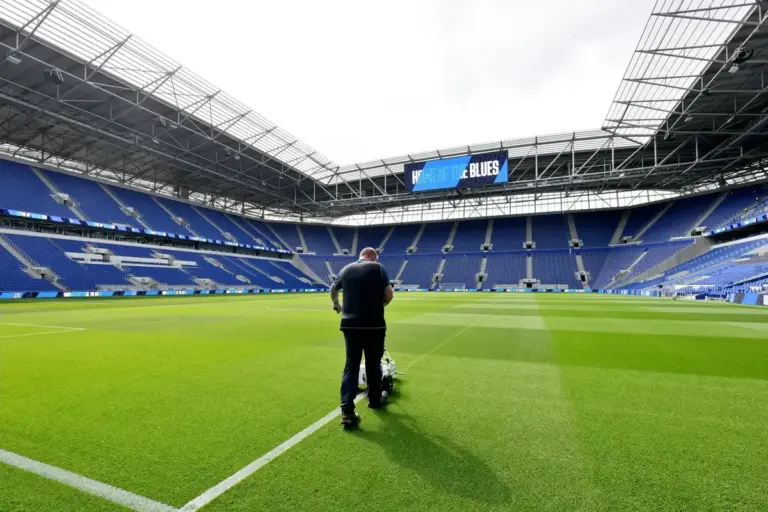
Everton now have the benefit of a full season at the Hill Dickinson Stadium, with its increased capacity and significantly greater commercial and matchday potential compared with Goodison Park.
Independent football-finance site PSRwatch currently models Everton’s position as follows:
| Measure | Current estimate |
|---|---|
| Relevant football income | £218m |
| Squad costs | £222m |
| Estimated Squad Cost Ratio | 102% |
| Premier League green threshold | 85% |
| Premier League red threshold | 115% |
| Estimated headroom to red threshold | £28m |
Source: PSRwatch modelling. Figures are estimates rather than official Premier League calculations.
The important number here is 102%.
That is Everton’s estimated Squad Cost Ratio — not 102% of the 85% threshold.
On this model, Everton are approximately 17 percentage points above the green threshold but 13 percentage points below the red threshold.
PSRwatch estimates that translates to roughly £28m of annual squad-cost headroom before Everton reach the red line.
Again, that should not be interpreted as Everton simply having another £28m available to spend on transfer fees.
A player’s impact on SCR depends on several factors, including his wages, contract length, transfer fee and associated costs.
What has changed this summer?
Everton have already undertaken significant transfer business.
The important thing under SCR is not simply how much the club pays or receives in headline transfer fees.
Incoming fees are generally spread across a player’s contract for accounting purposes through ‘amortisation’, while wages and agents’ costs also contribute to the annual squad-cost calculation.
Departures can create savings through wages and, depending on the player’s book value and transfer structure, affect Everton’s financial position in other ways.
Among the significant pieces of business affecting the picture are:
| Player | Movement | Likely SCR effect |
| Hayden Hackney | Incoming | Adds wages and annual amortisation |
| Christian Nørgaard | Incoming | Adds wages and annual amortisation |
| Merlin Rohl | Loan made permanent | Adds/continues annual squad cost |
| Tyrique George | Loan made permanent | Adds/continues annual squad cost |
| Brennan Johnson | Incoming via swap deal | Adds wages and accounting cost |
| Dwight McNeil | Outgoing via swap deal | Removes wages and affects accounting |
PSRwatch currently estimates that Everton’s confirmed summer transfer activity has reduced their available SCR headroom by approximately £30m on an annualised basis, although that calculation relies on estimated fees, wages and contract details where exact figures have not been made public.
It should therefore be treated as a model of Everton’s position rather than an exact club balance sheet.
Deals which could still change the picture
Everton’s position remains fluid with the transfer window still open.
Baris Alper Yilmaz remains one of the players linked with a move to the Hill Dickinson. Everton’s pursuit has encountered resistance from Galatasaray, and any eventual agreement would add both amortisation and wages to the annual SCR calculation.
A possible Richarlison return would also represent a significant commitment if Everton revived their interest and reached an agreement with Tottenham.
The headline transfer fee in either case would not simply be deducted from the estimated £28m of headroom.
For example, a £40m player signed on a five-year contract would ordinarily create approximately £8m of annual transfer amortisation before his wages and other associated costs were added.
That distinction is key to understanding how much room Everton actually have to manoeuvre.
Why missing Europe matters
Everton’s failure to qualify for European competition had two consequences for SCR.
The first is that the club operates under the Premier League’s 85% green threshold, rather than UEFA’s tighter squad-cost limit for clubs participating in its competitions.
The second is less helpful.
European qualification would have generated additional revenue through prize money, broadcasting, sponsorship opportunities and extra matchdays.
Because SCR measures squad costs against relevant revenue, increasing the income side of the equation can create additional room for investment.
Missing Europe therefore did not merely cost Everton potential prize money. It also denied the club revenue which could have increased its spending capacity under SCR.
Putting an exact figure on that lost opportunity is difficult because it would depend on which UEFA competition Everton entered and how far they progressed, so we will not include speculative European income in our running calculation.
The Hill Dickinson should help — but there is a caveat
Everton’s move to the Hill Dickinson Stadium represents one of the biggest changes to the club’s revenue potential in decades.
A full 2026/27 season should provide greater matchday and commercial income than was possible at Goodison Park.
That matters directly under SCR because greater relevant revenue can support greater squad expenditure.
There is, however, some nuance around how stadium income is recorded.
Everton’s food and drinks operation is outsourced. Under an outsourced model, the club generally recognises its contractual share of catering income rather than the entire value of sales generated inside the stadium.
That does not make outsourcing a bad financial arrangement — the operator also carries costs and commercial risk — but it means gross supporter spending inside the stadium should not automatically be treated as Everton revenue when attempting to model SCR.
For that reason, the financial benefit of the Hill Dickinson cannot accurately be calculated simply by multiplying attendance by estimated supporter spending.
So, can Everton still spend?
Yes — but the answer is more complicated than looking at the club’s transfer budget.
The current independent modelling suggests Everton have room below the Premier League’s red threshold, but are already operating above the 85% green line.
That makes the structure of any further deals important.
Contract length, wages, loan arrangements, sales and the timing of transactions can all materially change the annual squad-cost impact.
It also explains why an Everton side with substantially greater financial backing under The Friedkin Group cannot necessarily spend without restraint.
Under SCR, revenue is increasingly the key to spending power.
The Hill Dickinson Stadium should improve that. Further commercial growth would improve it again.
But Everton’s ability to continue strengthening the squad will ultimately depend on keeping those increased squad costs in proportion to the revenue the club can generate.
Everton SCR tracker
| Measure | Current estimate |
| Estimated SCR | 102% |
| Green threshold | 85% |
| Red threshold | 115% |
| Estimated headroom to red | £28m |
| Status | Above green / below red |
| Last updated | 20 August 2026 |
This tracker will be updated when transfer business, wage changes, published accounts or other significant financial information materially alter Everton’s estimated position. All SCR percentages and headroom figures are estimates based on publicly available information and independent modelling, not confirmed Premier League assessments.
For the latest incomings, outgoings and negotiations which could affect Everton’s position, follow our live transfer tracker.



Comments.
Loading comments…