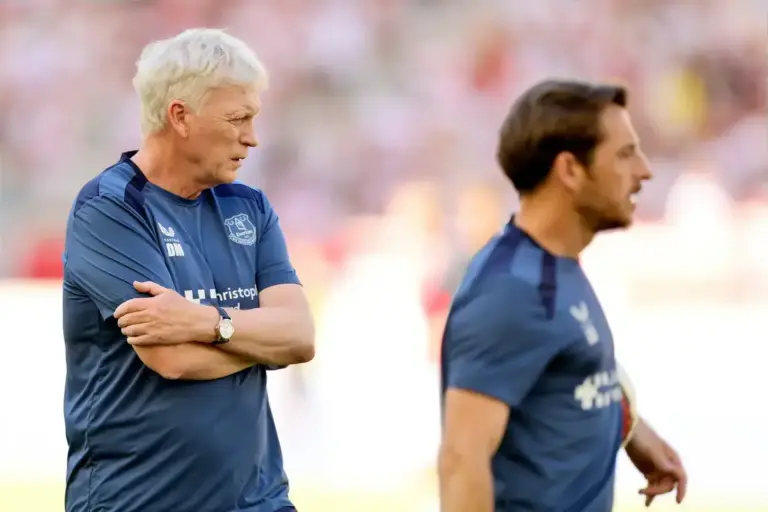

Everton said an emotional farewell to Goodison Park before moving into the state-of-the-art Hill Dickinson Stadium.
The new ground sits on the historic Bramley-Moore Dock waterfront in north Liverpool.
Everton have played at Goodison Park since 1892, giving the move genuine historical weight.
Indeed, the switch marks the biggest change in the club’s home since that year.

What is the capacity of Hill Dickinson Stadium?
Hill Dickinson Stadium gives Everton one of the largest capacities in the Premier League.
The new bowl comfortably exceeds what Goodison Park could hold.
Every stand offers unobstructed views of the pitch.
Moreover, the design keeps the atmosphere close to the touchline.
Hill Dickinson Stadium Capacity
The table below sets out the key numbers behind Everton’s new home.
| Full name | Hill Dickinson Stadium |
| Location | Bramley-Moore Dock, Liverpool |
| Capacity | 52,888 |
| Opened | 2025 |
The Stands at Hill Dickinson Stadium
Four stands make up Hill Dickinson Stadium, each with its own character.
Similarly to Goodison, supporters remain close to the pitch on every side.
The Main Stand
The Main Stand runs along one side of the ground.
It stands as a single tier and ranks among the largest of its kind in English football.
North Stand
The North Stand rises behind one goal in two tiers.
Home supporters fill this end on matchdays.
South Stand
The South Stand sits opposite the North Stand, giving the ground a balanced two-tier profile.
Meanwhile, it adds several thousand seats compared with the equivalent end at Goodison Park.
Park End
The Park End curves behind one goal and carries forward a name from Goodison Park.
Crucially, it keeps a link to the old ground alive inside the new one.
A Rich History: From Goodison Park to Hill Dickinson Stadium
Everton’s story stretches back to 1878, when the club first formed in Liverpool.
The team won its first league title in 1891, while still playing at Anfield.
Everton moved into purpose-built Goodison Park in 1892 and stayed for over 130 years.
Howard Kendall’s side later turned the club into the strongest in the country during the mid-1980s.
Therefore, Hill Dickinson Stadium now carries that history into a new setting.
Where is Hill Dickinson Stadium Located?
Hill Dickinson Stadium sits on Bramley-Moore Dock, on the Liverpool waterfront north of the city centre.
Meanwhile, the Mersey runs alongside the stadium, giving it a striking riverside setting.
Getting to Hill Dickinson Stadium: Transport & Parking
Everton have built strong transport links into the new stadium.
Indeed, public transport remains the easiest way to reach the ground on matchdays.
What is the nearest train station?
Sandhills station, on the Merseyrail Northern Line, sits closest to the stadium.
Supporters can walk from the station to the ground in a matter of minutes.
Can you drive to the stadium?
Driving to Hill Dickinson Stadium remains possible but parking near the ground stays limited.
Instead, the club encourages fans to use trains, buses or the Mersey Ferry.
The Everton fixtures and results page lists kick-off times to help with journey planning.
| Nearest train station | Sandhills (Merseyrail Northern Line) |
| Nearest city centre | Liverpool city centre, a short journey away |
| On-site parking | Very limited, pre-booking advised |
| Recommended travel | Train, bus or on foot |
| Ferry option | Mersey Ferry terminal at Liverpool Pier Head |
| Cycle access | Dedicated waterfront cycle routes |
Why Hill Dickinson Stadium is the New Home of Everton’s Soul
Hill Dickinson Stadium carries Everton’s identity forward from Goodison Park.
Finally, the club has a modern arena that matches its ambitions on the pitch.
Everton’s Major Honours
Everton’s trophy cabinet reflects over a century of top-flight football.
The table below lists the club’s major honours to date.
| Competition | Titles Won | Most Recent Win |
|---|---|---|
| League Championship | 9 | 1986–87 |
| FA Cup | 5 | 1994–95 |
| European Cup Winners’ Cup | 1 | 1984–85 |